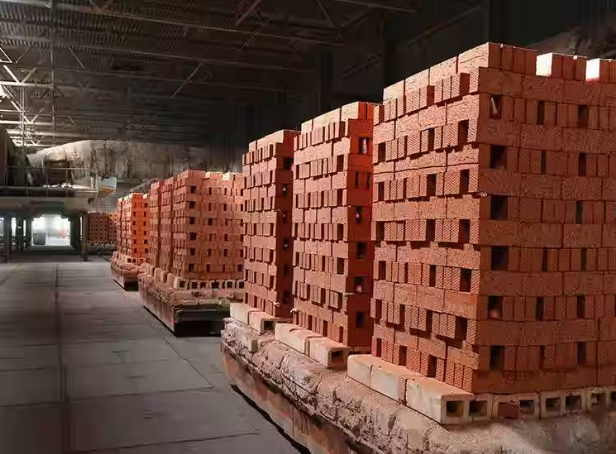
“Why does this brick have holes in it? Won’t that make the wall weak?”
It’s one of the most common questions on a construction site, usually from a home owner seeing a truckload of perforated bricks for the first time. It’s a fair question. A brick full of holes does look weaker than a solid one.
But the holes are there on purpose. And in most cases, they make the brick better, not worse.
What is an 8 hole brick?
An 8 hole brick is a burnt clay brick with eight vertical holes running through it from top to bottom. It is usually machine made, which keeps the size and hole pattern uniform. These bricks are also called 8 hole perforated bricks and are widely used for walls in homes, offices and commercial buildings.
Why do bricks have holes at all?
There are a few good reasons, and they add up.
The first is weight. Bricks with 8 holes use less clay, so each brick is lighter. Across thousands of bricks, that means less dead load on beams, columns and foundations, and less strain on the workers carrying them up to the third floor.
The second is bonding. When the mason lays the next course, a little mortar pushes into the holes and sets there. This forms small keys that help lock the courses together.
The third is firing. A solid brick can stay slightly under-fired in the centre while the outside is done. Holes let heat reach deeper inside the brick, so it tends to fire more evenly all the way through.
And the fourth is comfort. The air pockets inside the brick slow down the movement of heat and sound, which can help a room stay a bit cooler and quieter.
Are bricks with 8 holes strong enough?
Yes, when they’re made properly. Perforated clay bricks are an accepted building material in India, and the Bureau of Indian Standards has a specific standard for them, IS 2222, which covers burnt clay perforated building bricks.
Strength depends much more on clay quality, pressing and firing than on whether the brick has holes. A well-made 8 hole brick can easily outperform a poorly fired solid one.
For load-bearing walls, always ask the manufacturer for compressive strength test results, and let your structural engineer decide what’s suitable for your design. That’s not being fussy. That’s just good building.
Size also matters. Most 8 hole bricks in India follow a modular size close to the standard brick, so masons don’t need to change the way they work. Check the exact dimensions with your supplier before you finalise drawings, especially if you’re planning an exposed wall where joint lines need to line up neatly with windows, doors and corners.
Where can you use 8 hole perforated bricks?
They work well for load-bearing walls in low-rise buildings, internal and external walls in framed structures, partition walls and boundary walls. Because machine made perforated bricks have clean faces, they’re also popular for exposed brick facades where the holes stay hidden inside the wall.
A few laying tips
Keep the mortar at the right consistency. If it’s too wet, it simply drops down into the holes and gets wasted.
Lay the bricks with the holes running vertically, not sideways, so mortar can key in properly.
Clay bricks are usually soaked or wetted before laying so they don’t suck water out of the mortar too fast. Follow your manufacturer’s advice on this.
Be careful at the top of parapets, window sills and other places where water can collect. Exposed holes there can hold water. A solid brick course, a coping or a proper sill solves that easily.
How to choose the right bricks
Look closely at a few bricks from the real stock. The holes should be clean, straight and evenly spaced. Walls between the holes shouldn’t be cracked. All bricks should be the same size, and a gentle tap should give a clear, ringing sound.
Ask where the bricks are made, how long the company has been manufacturing, and whether test reports are available. Good suppliers are happy to share this.
If you’re sourcing in north India, Mahaluxmi Bricks is worth a call. The Haryana-based company, which started in 1982, makes machine made clay bricks along with blocks, jalis and roof and floor tiles, and follows an ISO 9001 certified quality system. You can check their options for 8 hole perforated bricks and other clay products on their site.
The short answer
Those eight holes aren’t a shortcut. They reduce weight, improve bonding, help firing and add a little insulation, all at the same time.
So the next time someone on site asks whether a brick with holes is weak, you’ll have a better answer than a shrug.