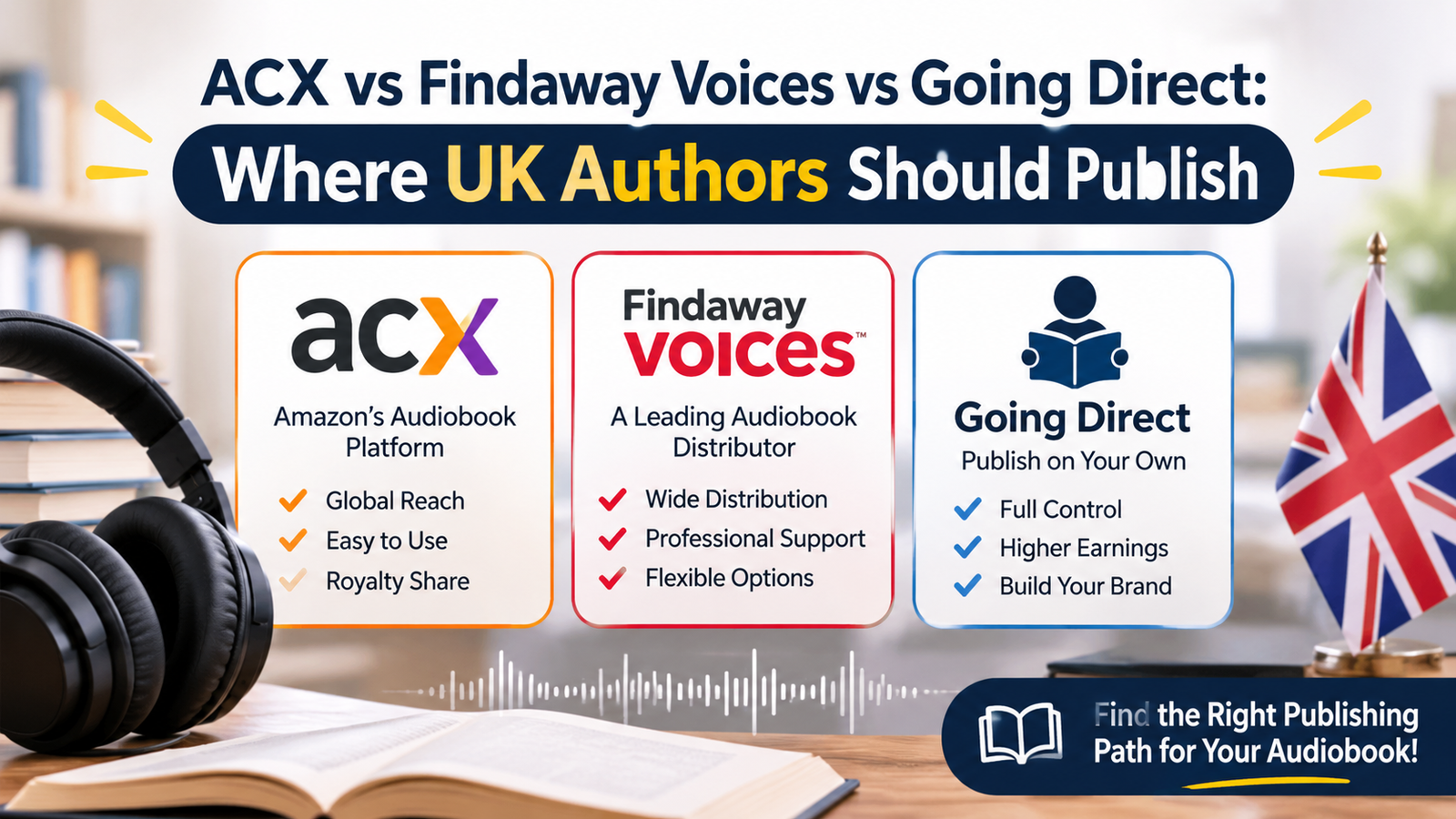
Once your audiobook is recorded, edited and mastered, the next question is where to put it. For UK authors, the three main options are ACX, Findaway Voices and selling direct to listeners. Each has different royalty rates, reach and levels of control, and the right choice depends on your goals. This guide compares them side by side. Platform terms change often, so confirm the current details on each site before you sign anything.
Why Your Distribution Choice Matters
Distribution affects how much you earn per sale, who can find your book and how long you are tied to one route. A wide spread of retailers and libraries can bring in steady income from many small sources, while a single big platform can deliver strong volume in one place. There is no universally correct answer, only a better fit for your book and your marketing.
Option 1: ACX
ACX is Amazon’s marketplace for audiobooks, and it connects authors with narrators as well as distributing finished titles to Audible, Amazon and Apple Books. It is available to UK and Irish rights holders, which makes it a natural starting point for many British authors.
Pros
- Direct access to Audible, the largest audiobook store in the world.
- A built-in marketplace for finding narrators and producers.
- A straightforward upload process with clear technical requirements.
Cons
- Exclusive distribution has historically paid around 40% royalties, but it locks you to ACX’s retail partners for seven years.
- Non-exclusive distribution has historically paid around 25%.
- Limited access to libraries and other stores if you choose exclusivity.
ACX works well for authors who want simplicity and whose readers already live inside the Amazon ecosystem. It is less suitable if library borrowing or alternative retailers are central to your strategy.
Option 2: Findaway Voices
Findaway Voices is a wide distributor, now part of Spotify, that sends audiobooks to a large network of retailers, subscription services and libraries. Its appeal is reach, and it lets you publish without giving up exclusivity.
Pros
- Distribution to many stores, subscription services and library platforms.
- No requirement to sign over exclusive rights.
- Useful tools for pricing, promotions and reporting.
Cons
- The platform takes a share of your earnings, so your royalty rate depends on the sales channel.
- Payments from many small sources can be harder to track.
- Audible access may be handled differently from ACX, depending on current terms.
Findaway Voices suits authors who want maximum visibility and library income, and who prefer to keep flexibility over where their titles are sold. Wide distribution tends to reward books that attract steady, long-tail interest rather than one big launch.
Option 3: Going Direct
Going direct means selling the audiobook production services yourself, through your own website, a direct-sales tool or a platform that lets independent authors set up storefronts. You collect the sale and the customer details, and you keep most of the revenue after payment fees.
Pros
- The highest potential earnings per sale.
- Full control over pricing, bundles and discounts.
- A direct relationship with your listeners, including their email addresses.
Cons
- You are responsible for marketing and for driving every sale.
- No built-in audience of the kind Audible offers.
- You handle customer support, file delivery and sometimes tax questions.
Going direct works best for authors with an engaged mailing list, a strong social following or a niche audience, such as business, wellness or specialist non-fiction. It is rarely enough on its own for a debut author with no existing audience.
Comparing the Three at a Glance
- Reach: Findaway Voices is widest, ACX is strongest on Audible, and direct is limited to your own audience.
- Control: direct gives you the most, with ACX exclusive giving you the least.
- Royalties per sale: direct is usually highest, though volume is lower.
- Effort: ACX is the simplest, while direct needs the most work from you.
- Library access: strongest through Findaway Voices.
Can You Combine Them?
Many authors do. A common approach is to use non-exclusive ACX distribution for Audible and Amazon, add Findaway Voices for libraries and other retailers, and run a direct store for your most loyal readers. The trade-off is that non-exclusive ACX pays a lower royalty rate, so you are exchanging a higher percentage for wider reach. Check each platform’s terms for overlap, because some do not allow the same title to be sold in conflicting ways.
Where Your Production Choices Fit In
Distribution decisions often connect to how you made the recording. If you hired a studio, ask whether the files are mastered to the standards of every platform you plan to use, since ACX and wide distributors each have their own requirements. Many audiobook production companies provide retailer-ready files for several platforms, and some will help with uploads and metadata as part of the package. Asking this before you commission the work saves you from re-mastering later.
Questions to Ask Before You Choose
- Which platform do my readers already use?
- Do I want library borrowing to be part of my strategy?
- Am I comfortable with a long exclusive contract?
- Do I have an audience I can sell to directly?
- How much time can I spend on marketing and customer support?
Final Thoughts
There is no single winner between ACX, Findaway Voices and going direct. ACX offers simplicity and Audible access, Findaway Voices offers reach and flexibility, and going direct offers control and the best margins for authors with an audience. For most UK authors, a blend of two or more routes will outperform any single choice. Start with the platform that matches your current audience, review your sales after a few months and adjust.