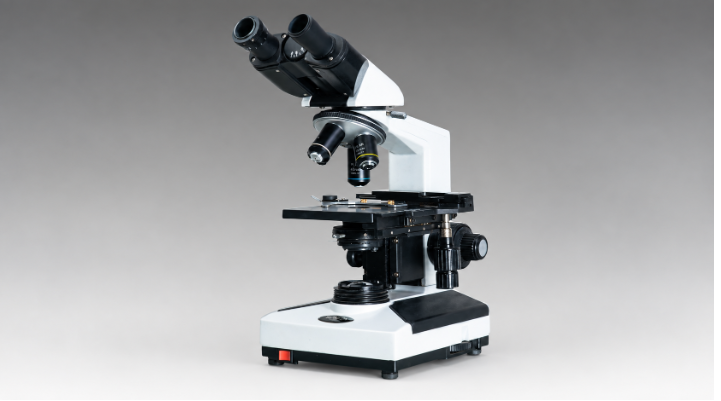
Ask which microscope brand is best in India and you will get an answer that depends entirely on who is answering. A school wants durability under forty pairs of hands. A pathology lab wants comfort across an eight-hour shift. A research department wants flat-field optics and a camera port.
No single brand is best at all three. The useful question is narrower: which company is best for what you are buying, and how would you know?
Four things separate them, and specifications are not one.
One: does the company manufacture, or does it import?
This is the first split and it explains most of what follows.
Companies that manufacture control their own optics, assembly and testing, hold spares for their own models, and can modify a configuration for a specific requirement. Companies that import and rebrand cannot do any of those things reliably, because the product is not theirs.
India has a real manufacturing base for this. Ambala in Haryana has produced scientific instruments for decades, and several firms there still grind, assemble and calibrate in-house. SUSWOX has manufactured there since 1973 and is one example among a handful of long-running units. Ask any company you are considering where its instruments are made, and note how specific the answer is.
Two: certification, and whether it covers the model quoted
The ISI mark confirms the instrument meets the relevant Bureau of Indian Standards specification. For government tenders and institutional purchases it is normally an eligibility requirement.
The detail that catches buyers out is scope. A company may hold certification for one range while quoting a model from another. Ask for the certificate against the exact model number, and check the date.
Three: who has actually installed what
Installation history is the most honest signal a microscope company gives, and it is the one buyers use least.
A company that has supplied medical colleges, AIIMS campuses, state universities and government laboratories has cleared technical evaluation repeatedly, delivered against tender conditions, and survived years of institutional service calls. That record is difficult to fake and easy to verify.
Ask for institutional references in your own segment. A firm strong in industrial inspection may have almost no history in teaching laboratories, and vice versa.
Four: what happens in year seven
Microscopes are long-life equipment. A laboratory instrument bought this year should still be working in 2040, and whether it does has very little to do with the brochure.
It depends on whether an objective can still be replaced, whether an illumination unit is still stocked, and whether service goes through the manufacturer or through a chain of intermediaries who may not exist by then.
So ask a company to name a model it sold ten years ago that it can still repair today. The answer, or the hesitation, tells you what you need.
A note on comparing prices across brands
Two quotations listing identical specifications are frequently not comparable. Objective quality, mechanical tolerance, illumination evenness and build materials all vary enormously within the same stated figures, and none of it appears on a comparison sheet.
The only reliable test available to a non-specialist is a demonstration. Bring a slide from your own lab, look at the edges of the field rather than the centre, move the stage, and use the fine focus. Differences that a specification sheet hides become obvious in a quarter of an hour.
Where reviews and marketplace listings mislead
Online listings for microscopes are unusually unreliable, and it is worth knowing why.
Ratings on marketplaces come overwhelmingly from hobbyist buyers of low-cost instruments, so a five-star average tells an institutional buyer almost nothing. Specification fields get filled in by sellers rather than manufacturers, and magnification figures in particular are frequently inflated by quoting eyepiece and objective combinations that no lab would actually use.
For an institutional purchase, ignore the listing and ask the manufacturer directly for a written quotation with model numbers, certification and warranty terms. It is slower by a day and accurate by a decade.
What about international brands?
They are excellent instruments and for some research applications there is no domestic equivalent. That is a fair reason to buy one.
The trade-offs are real though, and they are practical rather than technical. Service usually runs through an authorised distributor, spares can take weeks to arrive, and customisation is generally not available at all. For a research department with a specialised requirement and a budget to match, that is acceptable. For a teaching lab or a diagnostic centre running routine work, it is often a worse fit than a well-built domestic instrument with local support.
Match the choice to the work, not to the label on the arm.
The practical shortlist
Manufacturers over importers. Certification against the specific model. Institutional installations in your own segment. Spares availability measured in years, with an example.
Run those four filters and the list of microscope companies in India worth quoting from gets short quickly — which is the point. A shortlist of three you have actually checked beats a comparison of twelve you have not.
AUTHOR BIO (FOR THE PUBLISHING SITE)
Contributed by the team at SUSWOX, a microscope manufacturing company operating from Ambala, Haryana since 1973, with installations at AIIMS campuses, BHU and MDU Rohtak.
NOTES
Written as a neutral buyer guide — it names no competitor, which makes it easier to place.
Keep the in-body backlink in the manufacturing base section.
Suitable for education, procurement, healthcare infrastructure and industry blogs.