Mumbai is not one market. It is twenty markets stacked into one municipal boundary, each with its own income profile, buying behaviour and daily rhythm. A campaign that performs brilliantly in Mulund can fall flat in Lower Parel, and vice versa.
That is exactly why elevator advertising Mumbai has become such an effective channel for local brands. It is one of the few media that lets you buy Mumbai suburb by suburb, society by society — and pay only for the households you actually want.
This guide covers which categories convert in lift media, how to select societies, and what a well-structured 30-day plan looks like.
Why the Format Suits Mumbai Specifically
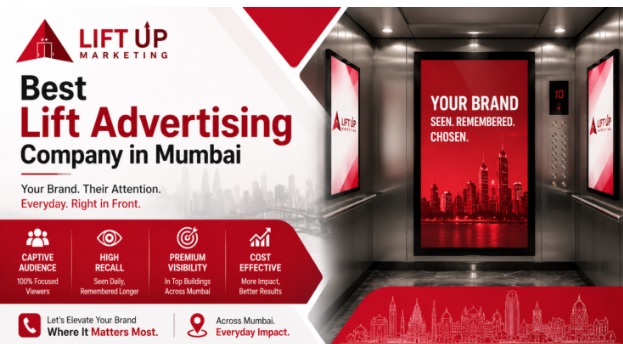
Elevator advertising places a poster of roughly 13″ x 19″, or a digital panel, inside residential and commercial lift cabins. Three of Mumbai’s defining characteristics amplify the format:
Vertical density. Towers of 20 to 60 floors are standard across Powai, Wadala, Goregaon, Thane, Chembur, Mulund and Navi Mumbai. A single complex can hold more families than a small town neighbourhood.
Long ride durations. Height translates directly into dwell time. A ride to the 34th floor gives your creative far longer than the national average — the medium simply works harder here.
Sharp building-level segmentation. Mumbai’s towers separate cleanly by income and lifestyle. That makes precision targeting practical in a way it rarely is elsewhere.
Combine these and you get a medium with very low wastage, very high frequency and genuine socio-economic control.
Which Categories Actually Convert
Not every business should buy lift media. Based on consistent category performance in residential elevator campaigns, these are the strongest fits:
Food and beverage. Cloud kitchens, cafés, bakeries, premium grocery, meat and seafood delivery. Riders are often heading home hungry, and a QR to order is a two-second decision.
Healthcare and diagnostics. Dental clinics, eye care, diagnostic labs, physiotherapy, IVF and paediatric practices. These are trust-led, proximity-driven decisions where repeated visibility in a resident’s own building carries unusual credibility.
Education. Preschools, coaching institutes, robotics and coding classes, music and dance academies. Parents choose within a 3 km radius almost without exception.
Fitness and wellness. Gyms, yoga studios, physiotherapy, salons and spas. The audience is literally between home and workout.
Home and interiors. Modular kitchens, interior designers, furniture brands, deep cleaning, pest control. New-possession towers are prime territory.
Real estate and financial services. Project launches, home loan advisors, insurance, wealth management. High ticket value justifies premium society placement.
D2C and app-based services. Laundry, pet care, tiffin services, subscription commerce. First-order promo codes convert well in this format.
The common denominator is a defined local catchment. If your customers come from nearby pin codes, the medium fits. If you have no geographic focus at all, spend elsewhere.
How to Select Societies, Suburb by Suburb
An experienced elevator ad agency Mumbai brands work with will guide this, but the logic is worth understanding yourself:
Step 1 — Map your real catchment. Plot where your existing customers come from. Most local businesses discover that 70 to 80 percent originate within a surprisingly tight radius. Buy that radius, not “Mumbai”.
Step 2 — Match society grade to product price point. A premium wellness brand and a value-segment grocery app need entirely different building sets even within the same suburb. Ask for household income profiling alongside the society list.
Step 3 — Prioritise depth over spread. One hundred lifts concentrated in Powai and Chandivali will build far more recall than one hundred lifts scattered from Borivali to Vashi. Hyperlocal media rewards density.
Step 4 — Check building age and occupancy. Newly possessed towers are excellent for interiors, furniture and home services. Established societies suit healthcare, education and daily-need categories.
Step 5 — Verify the inventory is real. Insist on the society list with localities, tower counts, lift counts and household estimates before payment, and on geo-tagged installation photographs afterwards. Agencies that manage creative and installation as one workflow are usually the ones with genuine society relationships.
A Practical 30-Day Plan
Pre-launch (week 0): Finalise the society cluster. Assign a unique promo code or QR per locality. Set up a campaign landing page and a dedicated WhatsApp number. Record baseline enquiries and walk-ins from the target pin codes.
Week 1: Installation completed and verified with dated photographs. Awareness creative goes live — brand, category and proximity.
Weeks 2–3: Response begins to build as frequency compounds. Monitor scans and calls by cluster. Identify which societies are performing.
Week 4: Switch to an offer creative with a deadline to convert accumulated recall into action. Compare final numbers against the baseline.
Month 2: Drop the underperforming societies, deepen in the winners, and rotate to a social-proof creative. This is where the channel starts compounding in your favour.
Creative Essentials for Mumbai Lifts
- One message, one action. Two calls to action roughly halve response.
- Heavy fonts, high contrast. Mirrored steel and tube lighting kill thin type and pastel palettes.
- Mount at eye level. In peak hours the lower third of the cabin is blocked by other riders.
- Generous QR size with quiet space. Cramped codes do not get scanned in poor light.
- Name the locality. “Now open in Powai” consistently outperforms “Now open in Mumbai”.
- Rotate monthly. Daily riders stop noticing an unchanged poster.
Final Thoughts
Mumbai’s advertising market is expensive and noisy, and most of the budget goes into places where attention is fleeting. The lift cabin remains one of the very few environments where a brand is seen properly, repeatedly, at close range, by exactly the households it wants to reach.
The medium rewards precision — the right suburbs, the right societies, the right creative, measured honestly.
LiftUp has been building brands inside residential elevators since 2017 for categories ranging from national QSR chains to neighbourhood service businesses. See the brands we have worked with, read about our approach to elevator media, or request a society-wise plan for your Mumbai catchment.
FAQs
Q1. Which Mumbai suburbs are best for elevator advertising? It depends entirely on your catchment. High-density residential belts such as Powai, Thane, Mulund, Chembur, Goregaon, Kandivali and Navi Mumbai offer large society inventory, but the right choice is whichever suburbs your customers already come from.
Q2. How many lifts should a first campaign cover? Concentrate rather than spread. A dense cluster within one or two adjacent localities for thirty days produces better learning and better recall than a thin city-wide buy.
Q3. Is elevator advertising suitable for premium brands? Yes. Mumbai’s towers are sharply segmented by income, making precise matching of premium products to premium buildings straightforward.
Q4. How do I track results from a lift campaign? Assign a unique QR or promo code to each locality cluster, route it to a dedicated landing page or WhatsApp number, and compare enquiries against a pre-campaign baseline for the same pin codes.
Q5. What happens if a society refuses the advertisement? Reputable agencies operate only on contracted, permitted inventory and will substitute an equivalent society if any location becomes unavailable. Confirm this clause before booking.