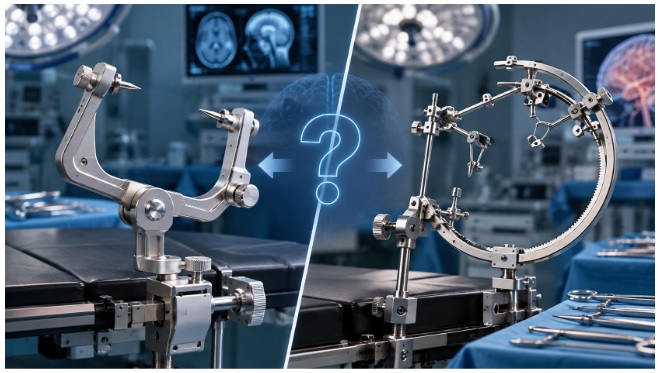
Two hospitals, same year, same budget range. One bought a three-point Mayfield type system. The other bought a Sugita frame.
Both were right. And if they had swapped, both would have been wrong.
This is one of those procurement decisions where the specification sheet genuinely cannot answer the question for you. It depends almost entirely on what your neuro list looks like on a normal Tuesday.
What each one actually does
A Mayfield type attachment holds the head. That is its job, and it does it with three pins — two on a rocker arm on one side, one opposing them from the other — locked through an adaptor to a base unit on the operating table.
A Sugita frame, sometimes written Sujita in Indian catalogues, does the same job with more pin positions, usually four to six. But the bigger difference is that the Sugita basal frame also acts as a mounting platform. Self-retaining retractors, blades and accessories attach to the frame itself, ringing the surgical field.
So one is a fixation device. The other is a fixation device plus a workstation.
Where the Mayfield type wins
Speed, mostly. Fewer components, faster to set up, faster to strike down.
For a general neurosurgical and spinal list — craniotomy, tumour resection, posterior fossa work, posterior cervical laminectomy, fusion, craniovertebral junction surgery, trauma decompression — three-point fixation covers it comfortably. It supports supine, prone, lateral and sitting positions on one system, which is the practical reason the design has outlived nearly every alternative.
It also has a smaller footprint around the head. In a crowded theatre with a microscope, a navigation camera and an assistant, that space is not nothing.
And it costs less, both to buy and to maintain.
Where the Sugita earns its cost
Extended microneurosurgery. Aneurysm work, AVM, deep tumour resection — cases that run long and need sustained retraction.
If an assistant is otherwise standing there holding a retractor for three hours, the integrated frame pays for itself in staffing alone. The retraction is steadier than a human hand, and the surgeon is not asking someone to adjust it every ten minutes.
The trade-offs are honest ones. More components to assemble, longer setup, a larger structure around the field, and a higher price. For a theatre doing two long microneuro cases a month, that is a lot of frame sitting in storage.
The question that actually decides it
Forget the brochures for a moment and look at your OT register.
Count your neuro cases over the last six months. Split them into two buckets — cases where the head simply needed to stay still, and cases where sustained retraction was needed for more than an hour. If the second bucket is small, a Mayfield neuro attachment is the sensible buy, and you can add a separately mounted retractor system later if the case mix changes.
If the second bucket is substantial and growing, the Sugita frame starts making sense.
A fair number of well-run neuro theatres eventually own both. They just do not buy both at once.
What does not change either way
Whichever route you take, the same practical checks apply, and they are the ones that get skipped.
Confirm the mounting before you order. Your table rail cross-section, whether there are head-end receptacle holes and at what spacing, and whether the head section is removable. A system that will not mount is an expensive paperweight no matter which design it follows.
Confirm the kit is complete. A proper three-point kit includes the clamp, base unit, ball socket adaptor, horseshoe headrest and both adult and paediatric skull pin sets. The headrest and the paediatric pins are not optional extras, whatever the quotation implies.
Confirm spares availability for the exact model, and ask how skull pins are supplied. They should be a routine consumable line, not something you chase when the tips go dull.
And ask whether the supplier manufactures or trades. When a lock handle wears out in year four, a factory can make you one. A reseller can only forward your email. Indian manufacturers that machine in-house — Ventek India among them, working out of its Bawana plant in New Delhi — tend to answer the spares question without checking with someone else first.
A note on buying the table at the same time
If the neuro theatre is new, specify the table and the attachment together.
Compatibility then gets confirmed on the quotation rather than discovered at installation, and somebody checks that the operating light working field, the table articulation and the attachment mounting envelope do not conflict. Companies that make all three — Ventek India manufactures OT tables, shadowless lights and pendants alongside its neuro attachments — can run that check in one specification review. When three different vendors supply three different items, it almost never happens.
The two hospitals in the opening both got it right, incidentally. One ran a broad general neuro list. The other did high-volume aneurysm work.
Same equipment category. Completely different answer. That is the whole point.