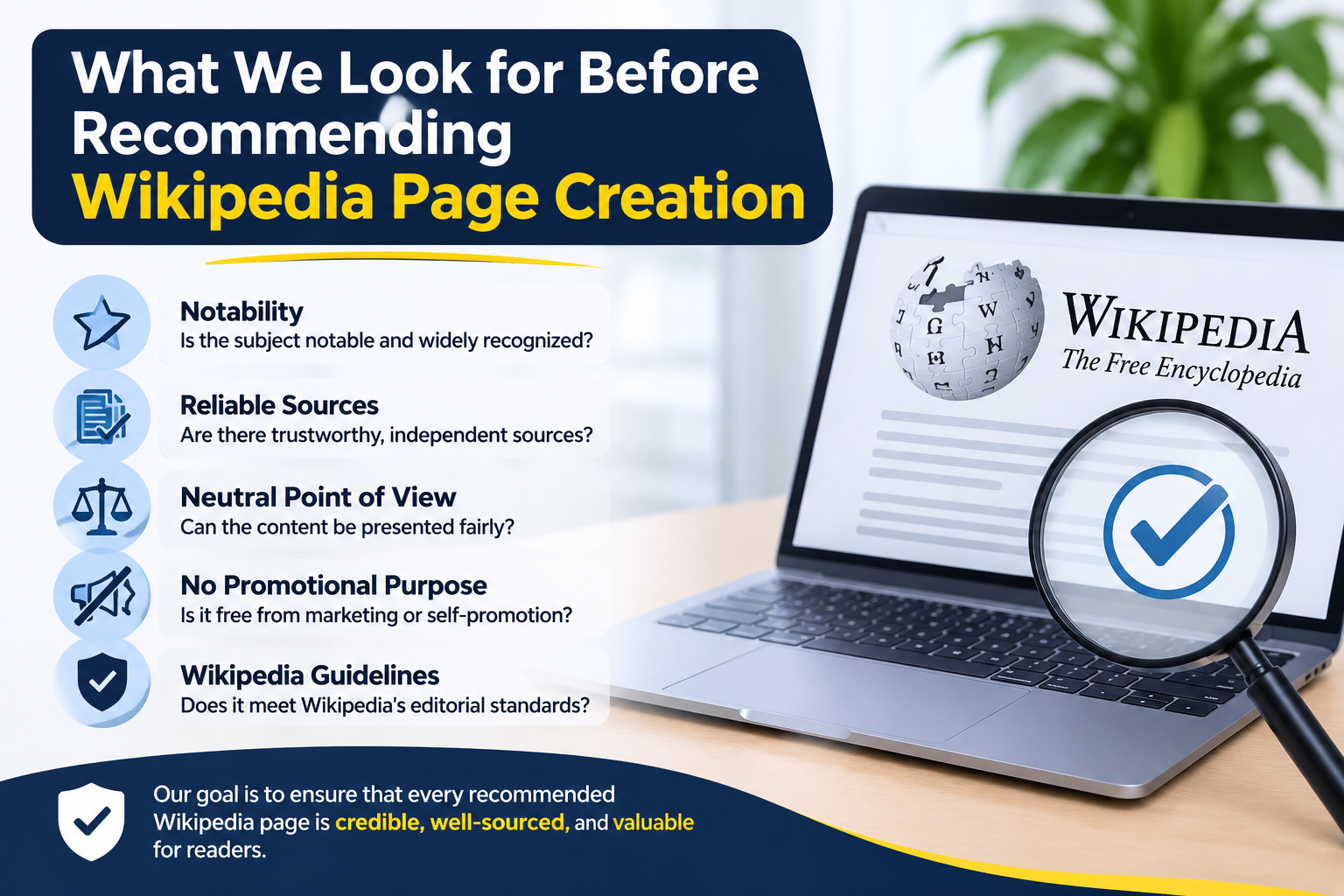
A request for a Wikipedia article often begins with an impressive biography, a company milestone, or a collection of press links. None of those materials automatically answers the central editorial question. Does the subject have enough independent, reliable coverage to justify a standalone encyclopedia article? A careful assessment begins with that question rather than with a promise to publish.
When assessing a new enquiry, an ethical consultant should explain what a wikipedia page creation service can realistically evaluate and what remains outside anyone’s control. The assessment may reveal strong evidence, a significant source gap, or a topic better covered elsewhere. This distinction matters because Wikipedia reviewers are volunteers who apply community policies, not customers who approve an article because a fee was paid.
Start with the subject rather than the sales pitch
A founder may describe a remarkable business journey, but an encyclopedia is not a company profile. We would first identify the exact subject being proposed and whether it is an individual, corporation, product, or event. Those categories can raise different sourcing questions. We also separate material provided by the subject from independent reporting. A polished media kit can help identify dates and names, yet it cannot establish public significance merely by presenting flattering achievements. This first distinction prevents hours of drafting around claims that cannot be supported neutrally.
Build a source inventory before writing
A useful first deliverable is a source inventory that records the publication, author, publication date, link, level of detail, and connection to the subject. For each article, ask whether a journalist or independent writer investigated the subject or simply republished supplied statements. An interview may contain valuable facts but often gives a subject substantial control over the narrative. A press release, even on a recognised news website, is still promotional material. The goal is to find multiple pieces that provide meaningful independent discussion, not merely mention a name.
Test coverage for substance and independence
A headline naming a company is not the same as a reported article that explains its business model, history, impact, and criticism. Likewise, a list of award nominees may confirm an award but contribute little to a general notability case. We would read complete articles rather than rely on search snippets. We also check ownership relationships, sponsorship notices, and syndication. Five websites carrying the same corporate announcement should not be presented as five independent investigations. Editorial independence matters at least as much as the reputation of the publication.
Check whether the strongest claims can be verified
Before drafting, identify which statements a careful reader would reasonably expect to verify. Dates of incorporation, job titles, revenue figures, awards, and allegations need suitable sources. Claims about living people require particular caution because errors can cause harm. The source must support the precise statement being made, rather than something only loosely related. This process sometimes exposes an uncomfortable gap between what marketing materials say and what public records establish. Finding that gap early is a sign of diligence, not a reason to stretch the evidence.
Explain the outcome in plain language
A meaningful recommendation should not be limited to a yes or no. It should explain which sources carry the most weight, which claims remain unsupported, and what might lead a volunteer reviewer to question the draft. This is also the point at which wikipedia writing services providers should disclose any paid relationship and clarify how a conflict of interest will be handled. Clients should understand that a positive preliminary assessment is an editorial opinion, not approval by Wikipedia. The strongest professional advice may be to postpone the project rather than submit a weak article.
Separate the draft from the publication decision
A draft can be clear, accurate, and well referenced yet still fail an independent notability assessment. Conversely, a notable subject can be poorly represented by an article that reads like an advertisement. These are separate issues. The consultant can control research quality, attribution, neutrality, and responsiveness to feedback, but cannot control whether an uninvolved reviewer accepts a submission. Explain these boundaries before a client signs an agreement. That protects expectations and helps preserve trust if the review takes an unexpected direction.
Look for editorial risks beyond notability
We also consider copyright, excessively promotional wording, unbalanced coverage, and potentially contentious statements about living people. Copying an executive biography from an official website can create a copyright problem even when every sentence is factually accurate. A draft that gives several paragraphs to awards but ignores well documented criticism may raise neutrality concerns. A responsible review therefore looks at the entire proposed article, not just the volume of citations. The safest approach is to outline the article from independent sources and write original, restrained prose.
Offer a decision that protects the client
Not every enquiry should become a writing project. Sometimes the better recommendation is to keep a source register, correct factual information on an existing article through appropriate channels, or wait until independent reporting develops naturally. Publishing promotional placements solely to manufacture notability is not a sound substitute for editorial coverage. A transparent assessment helps the client avoid unnecessary cost and the reputational risk of a rejected promotional draft. It also gives them a clearer picture of what Wikipedia is designed to document.
What a documented recommendation can include
A useful assessment can end with a concise written summary of the proposed subject, the applicable notability questions, and a ranked discussion of the strongest sources. It can flag material that should be omitted, such as private details or statements supported only by advertising. An evidence register also makes later updates easier when a client discovers new coverage. Rather than assigning a fictional approval probability, advisers can describe the remaining uncertainty and explain what new facts would change their judgement. This practical record is useful even when the client decides not to commission a draft. It shows precisely what the consultation established and gives a future editor a reliable starting point. Clear documentation is particularly important when the person making the enquiry is not the subject and may misunderstand which public sources are available.
Final Thoughts
The most valuable recommendation is one backed by a readable explanation of evidence, uncertainty, and policy. Wikipedia decisions should be approached with respect for independent review, not as a guaranteed marketing deliverable. By leading with source research and clear expectations, an adviser can provide useful expertise even when the recommendation is not to proceed.