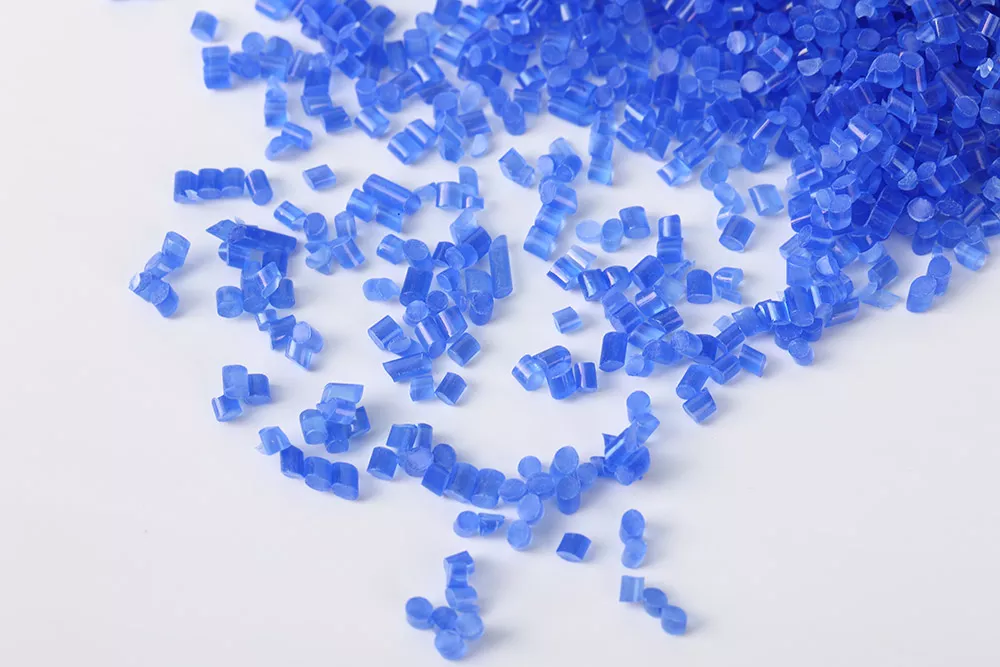
TPU Masterbatch and Transparent Masterbatch are sometimes mentioned together, but they solve different problems. One is defined by the polymer it is built for; the other by the optical result it delivers. Treating them as interchangeable leads to poor material choices. This guide clarifies what each is, where it fits, and how to select between them.
Understanding TPU Masterbatch
Thermoplastic polyurethane (TPU) is a flexible, abrasion-resistant polymer used where elasticity and toughness matter. A TPU masterbatch is a color or additive concentrate built on a TPU-compatible carrier so it disperses cleanly in the base polymer without harming its flexibility or clarity.
TPU is common in:
• Footwear components
• Flexible tubing and hoses
• Cables and wire jacketing
• Sporting goods
• Films and protective sheets
Because TPU processes differently from rigid plastics and can be sensitive to moisture and heat, its masterbatch needs a compatible carrier and heat-stable colourants. Choosing suitable TPU masterbatch grades helps maintain the polymer’s characteristic softness and resilience while achieving the desired colour.
Understanding Transparent Masterbatch
A transparent masterbatch is defined by its optical goal rather than a single polymer. It is used to color or modify plastics while preserving clarity, so the finished part remains see-through or translucent. This calls for carefully selected colorants and additives that tint without clouding the material.
Transparent masterbatch is used in:
• Clear packaging and containers
• Transparent films
• Consumer products where visibility matters
• Tinted but see-through components
Achieving good transparency depends on colourant selection, dispersion, and compatibility with the base polymer. Poor dispersion or the wrong pigment can introduce haze that defeats the purpose.
Key Differences at a Glance
| Aspect | TPU Masterbatch | Transparent Masterbatch |
| Defined by | Base polymer (TPU) | Optical result (clarity) |
| Primary goal | Colour/function in flexible TPU | Colour while keeping transparency |
| Typical uses | Footwear, tubing, cables | Clear packaging, films |
| Main challenge | Carrier compatibility, flexibility | Avoiding haze, dispersion |
The two are not alternatives to each other. You could, in principle, need a transparent effect within a TPU part, which would require careful formulation addressing both goals at once.
Selection Considerations
When choosing either type, weigh the following:
• Base polymer: Match the carrier to your resin. A TPU part needs a TPU-compatible system.
• Optical requirement: Decide whether clarity is essential, since that drives colourant choice.
• Processing conditions: Temperature, shear, and moisture sensitivity affect results, especially with TPU.
• End-use demands: Flexibility, abrasion resistance, or clarity should guide the formulation.
Because outcomes depend on formulation and processing, request samples and validate on your own equipment before scaling up.
Processing Notes
TPU is moisture-sensitive and benefits from proper drying before processing. Transparent grades demand tight dispersion control to avoid haze. In both cases, matching processing conditions to the material is essential, and supplier guidance helps avoid common defects such as colour shift or cloudiness.
Conclusion
TPU masterbatch and transparent masterbatch address distinct needs: one serves a specific flexible polymer, the other a specific optical result. Selecting correctly starts with your base polymer and your clarity requirements, then extends to processing and end-use demands. Clear specifications and sample trials are the reliable route to a grade that performs as intended.
Frequently Asked Questions
Can TPU masterbatch be used for all TPU grades?
No. Compatibility depends on the TPU grade, processing conditions, and the masterbatch carrier system. Always confirm suitability before production.
How do you choose a TPU masterbatch?
Consider the TPU grade, required colour, processing temperature, dosage, and required mechanical and optical properties.
Does TPU masterbatch affect the flexibility of the final product?
It can if the formulation or dosage is unsuitable. A compatible masterbatch helps maintain the required flexibility and performance of the TPU part.
What dosage of TPU masterbatch is recommended?
The dosage depends on the colour strength, TPU grade, and required shade. The supplier should provide a recommended let-down ratio based on the application.
Can TPU masterbatch be used in injection molding?
Yes. TPU masterbatch is suitable for injection molding when the grade and carrier system are compatible with the processing conditions.
Can TPU masterbatch be used for extrusion?
Yes. It can be formulated for TPU extrusion applications, provided the masterbatch is compatible with the resin and processing temperature.
How do you maintain colour consistency in TPU products?
Use a compatible masterbatch, maintain consistent dosage, and control processing conditions. Production trials help confirm shade consistency.
Can transparent TPU be coloured without losing clarity?
Yes, with a suitable transparent colourant and carefully controlled formulation. Excessive pigment loading can reduce clarity.